

We serve bear paw about 300 times a year.
In China it is known as xiongzhang (熊掌) and has been treated as a delicacy of the highest order for centuries. In Japan, though, almost no restaurant actually serves it. Not because it cannot be obtained — because the work needed to make it edible is out of all proportion.
This article sets out what that work involves, and what bear paw actually tastes like.
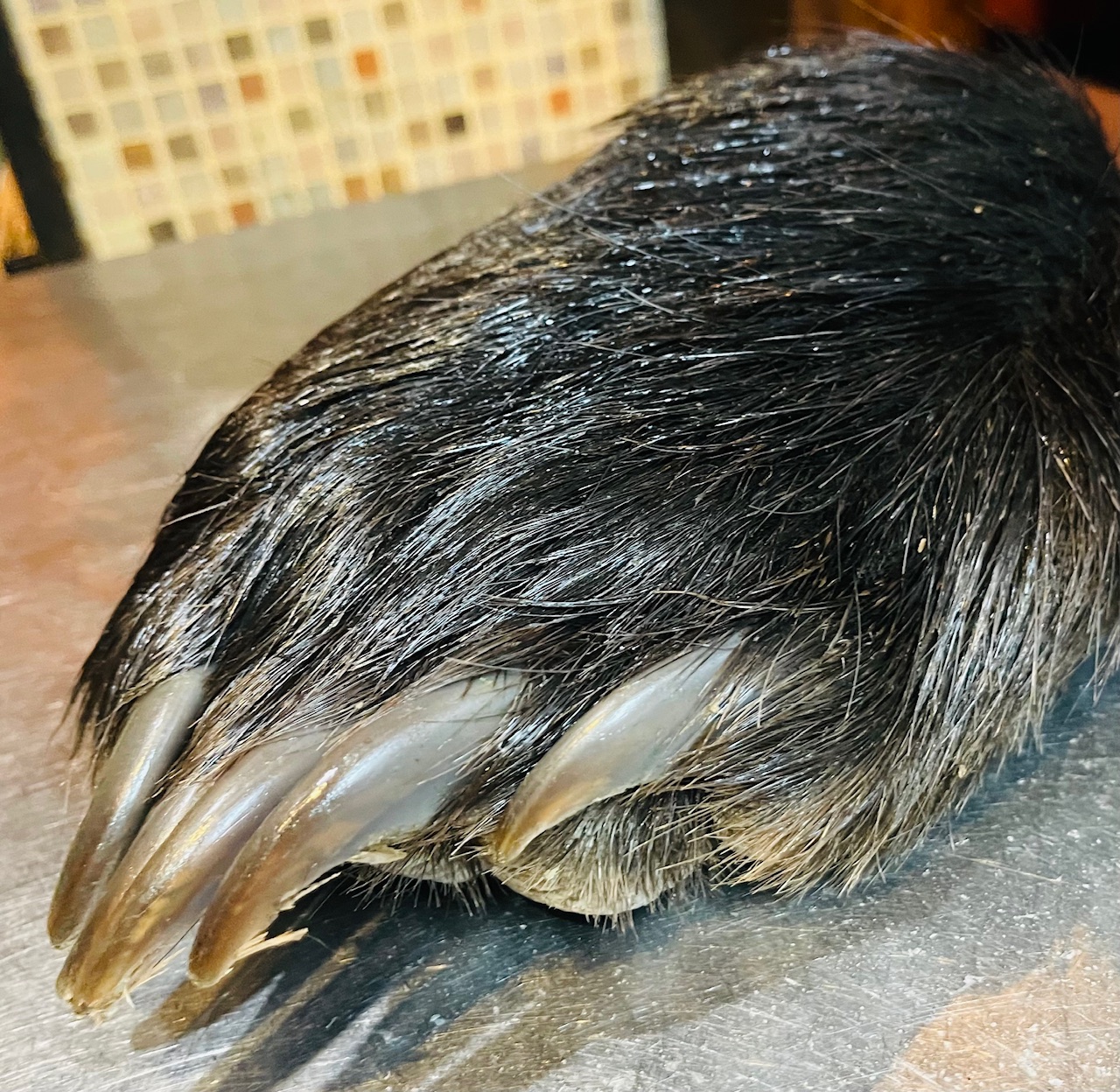
Where our bear paws come from
Most of what we use comes from Asiatic black bears in Akita, Nagano, Gifu and Niigata. Brown bear paws we order in from Hokkaido when a guest asks for them.
You cannot buy bear paws on their own. We buy the whole animal, so the front and hind paws arrive together — four paws from one bear. That is what sets the number of servings we can offer in a year.
Brown bear and black bear paws are not the same size at all
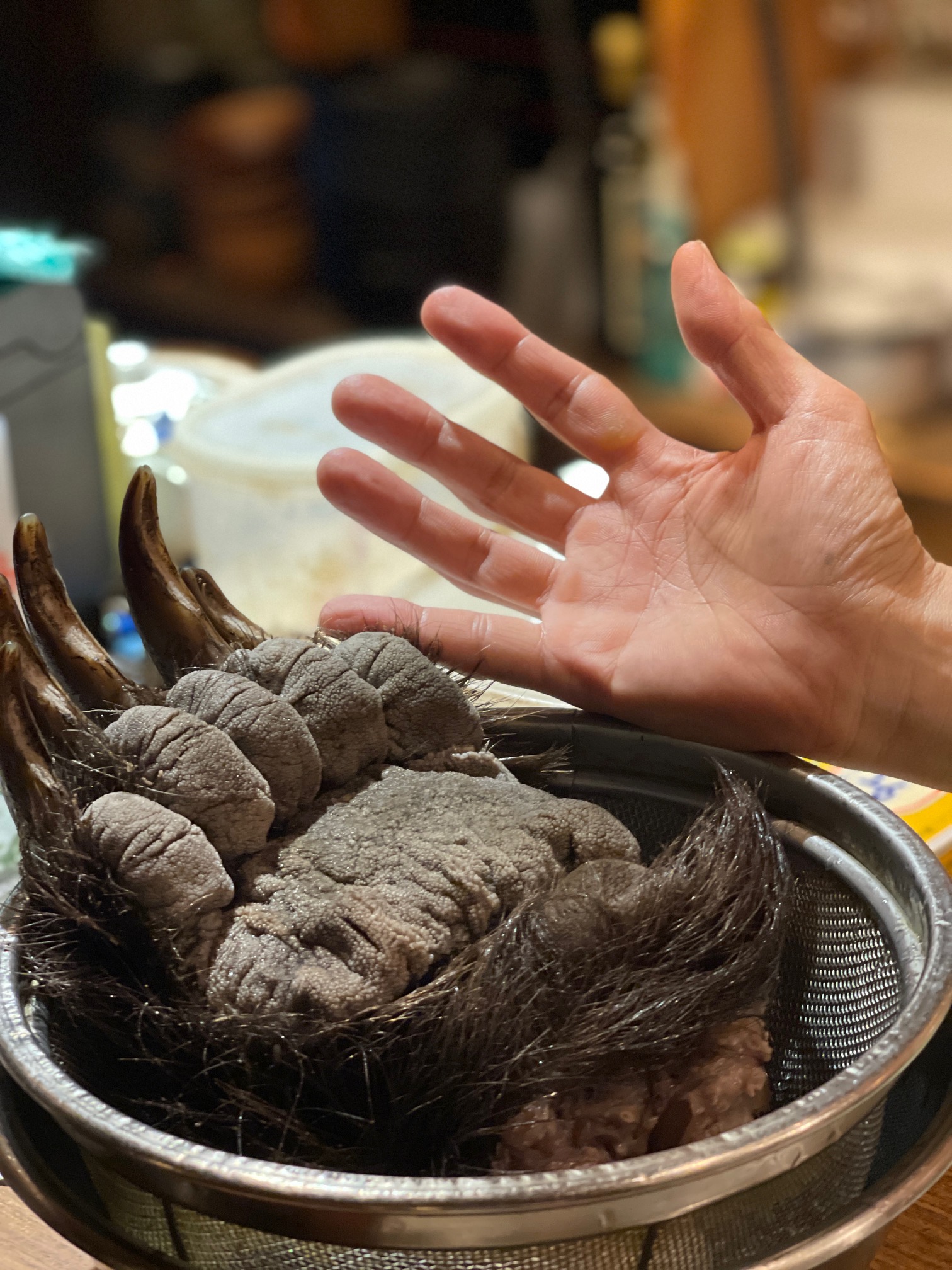
Even under the same name, a brown bear’s paw is big. A large one can be more than twice the size of a black bear’s.
And that is not just a matter of appearance. Size translates directly into preparation time, so we decide how long a paw goes over the heat only after seeing what arrived that day.
Front paws and hind paws are eaten differently
This does not get written about much, but front and hind paws are different things.
| Character | Best suited to | |
|---|---|---|
| Front paw | More collagen and more bone; less edible meat than the hind paw | Braising |
| Hind paw | More edible meat | Charcoal grilling, by a wide margin |
A word about the pads. You will sometimes read that the pad has a texture like fish skin, but we do not serve the pads at present: they are tough and awkward to eat. Taking an animal does not mean everything on it should go on a plate, so I would rather say that plainly.
What bear paw tastes like
Bear meat itself is deep red meat with a generous layer of fat, juicy, and often said to be close to beef. For more on the meat, see our English article What Is Bear Meat? Taste, Smell, Season and How to Choose It.
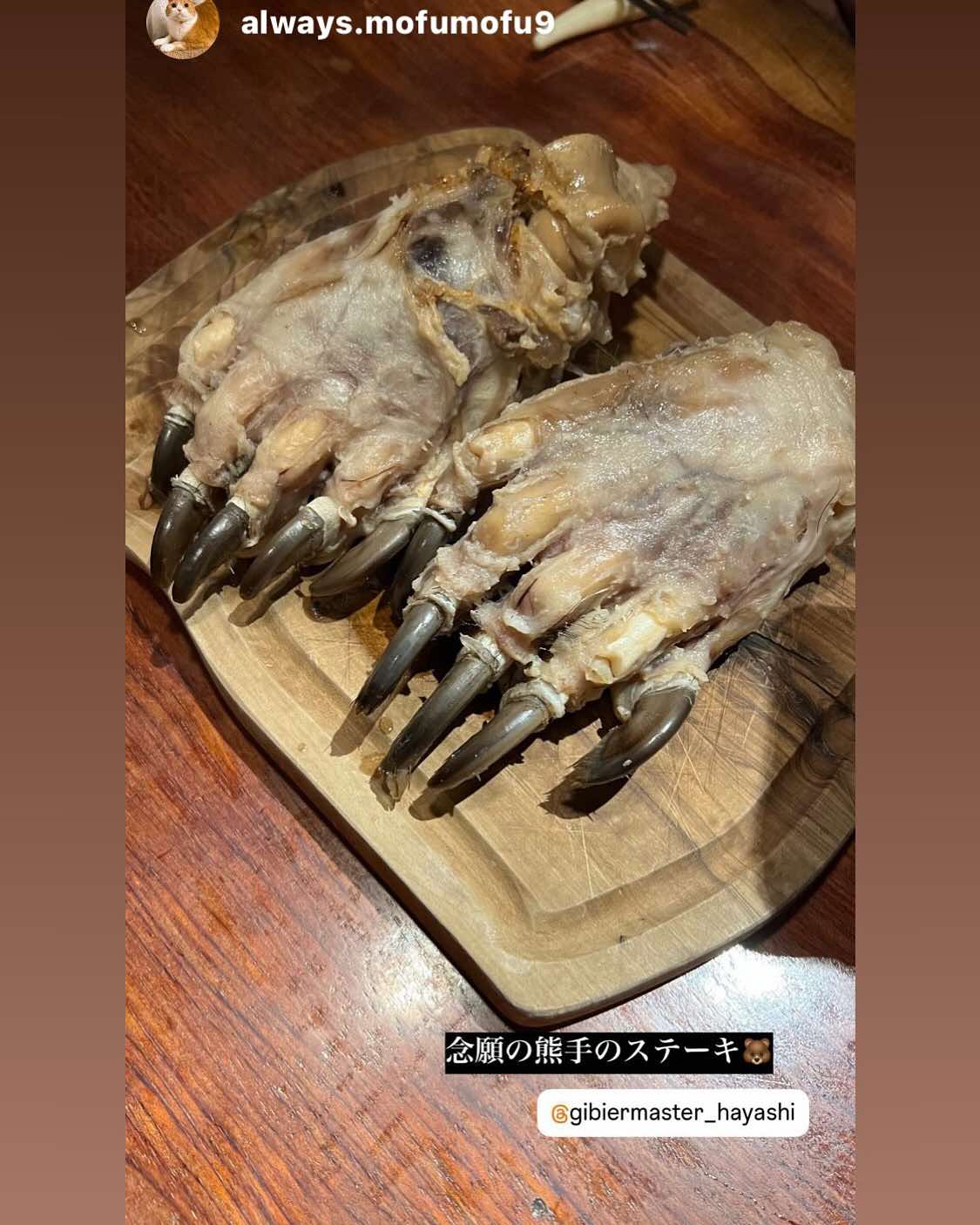
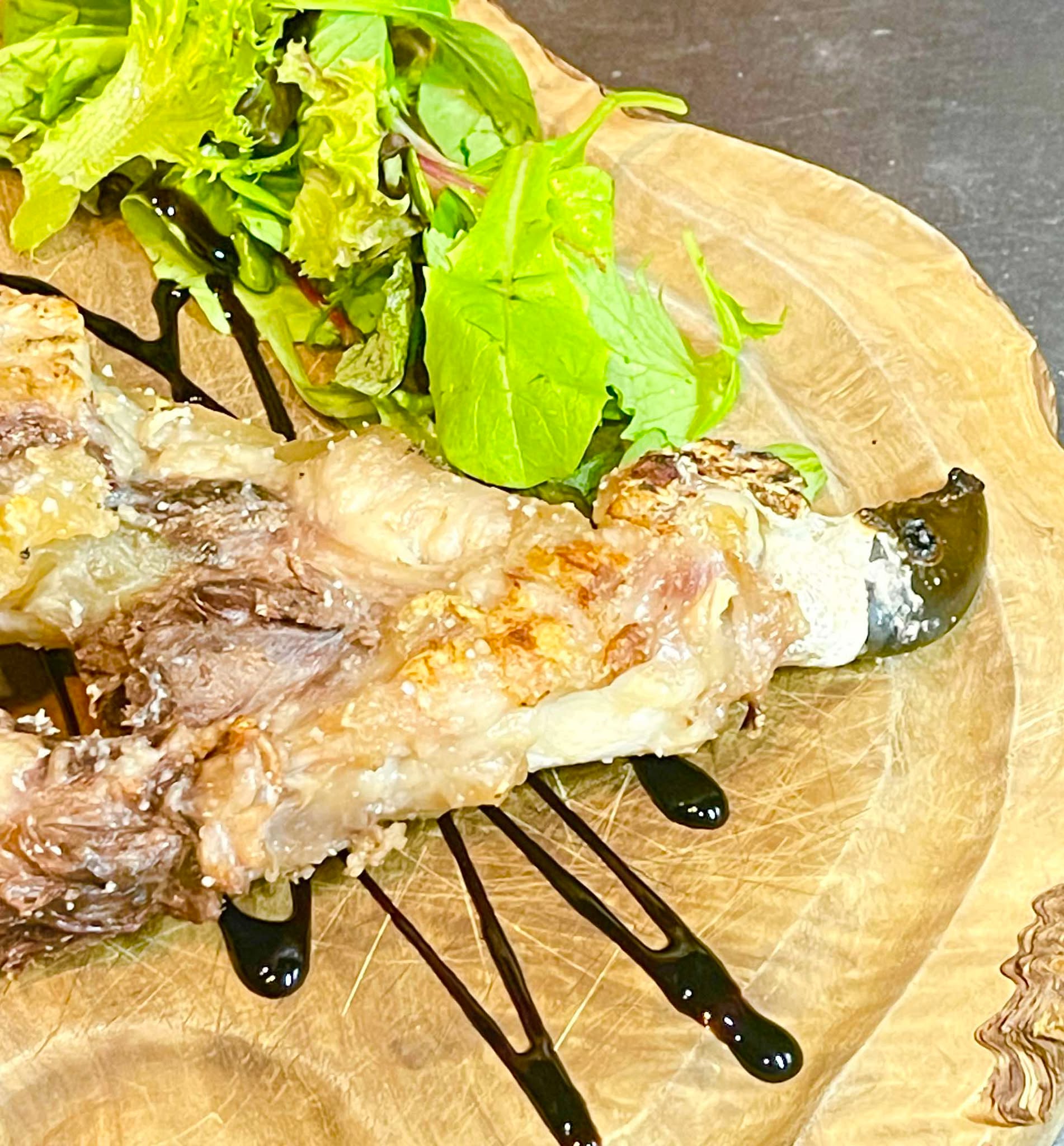
The paw is lighter than that. What you are eating is not really the flavour of meat but a soft, gelatinous texture. It is close to pork trotter, and comparisons with shark fin or soft-shell turtle are fair ones. Because the flavour does not assert itself, the sauce or seasoning changes the impression completely.
More than a full day before it can be eaten
This is the reason bear paw is so rarely served.
| Step | What it involves | Time |
|---|---|---|
| 1. Plucking | Pulling the hair off the paw with pliers | — |
| 2. Searing | Burning off the remaining hair carefully with a torch | — |
| 3. First simmer | When finishing it Chinese-style | Half a day |
| 4. Main braise | Varies with the size of the paw | 5–12 hours |
Half a day on the first simmer, then five to twelve hours on the main braise. Added together it comes to more than a full day.
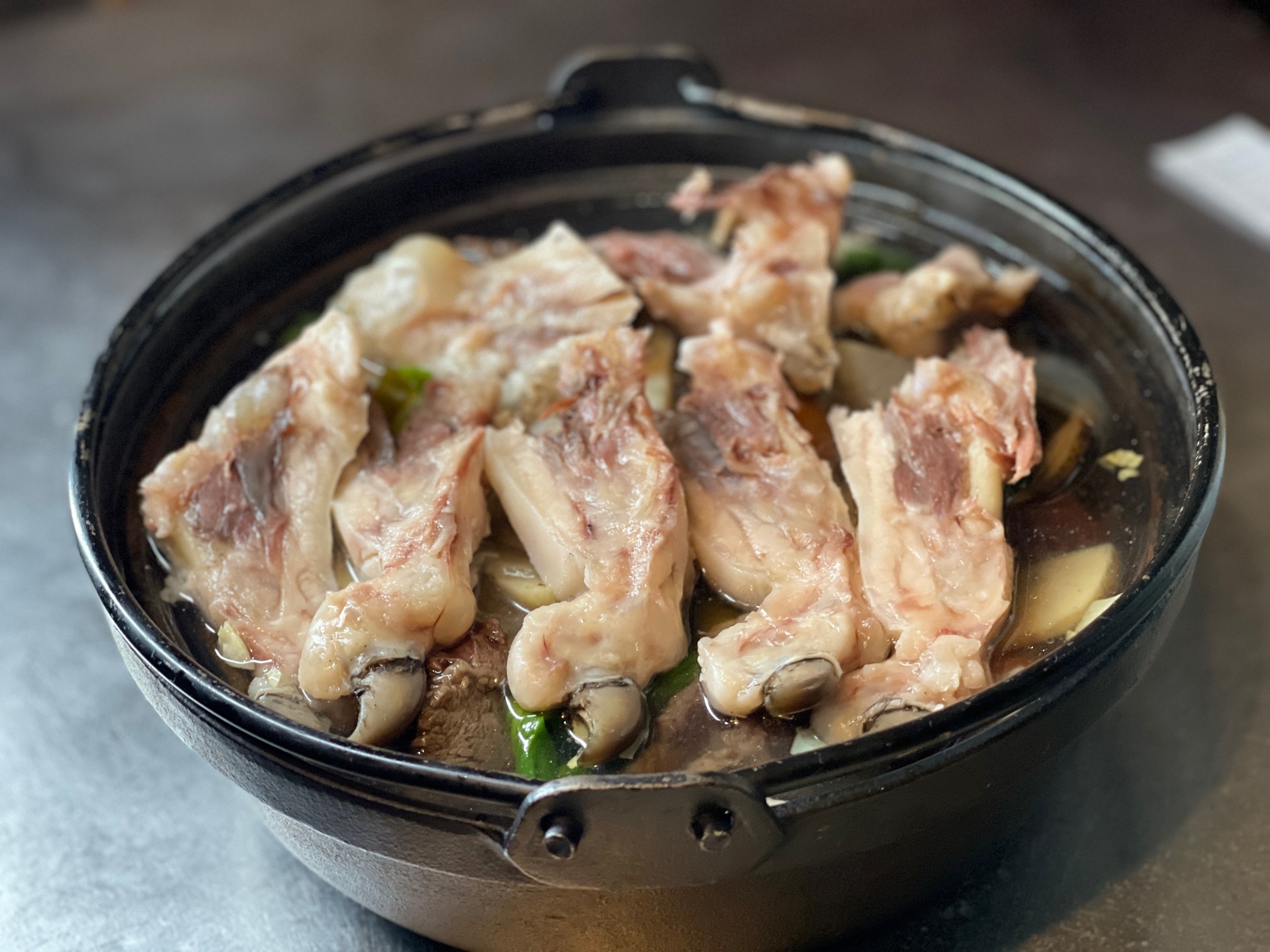
For seasoning we sometimes use miso, which helps hold down the gaminess, and sometimes braise the paw in a Chinese-style sauce. Bear meat can be cooked all sorts of ways — grilled, or sliced for shabu-shabu — but with bear paw, braising is the basis.
The hardest part
Getting used to the hair preparation took me a long time. It was genuinely difficult.
And the first simmer is still the step I cannot take my eyes off. The time it needs changes considerably with the size of the paw, so you cannot judge it by the clock alone. Two things called by the same name — a black bear’s smaller front paw and a brown bear’s hind paw — are close to being different ingredients. It is work that does not let you look away.
How guests react
The reaction when we bring bear paw to the table is a little different from other dishes.
A sound comes out before any words — a kind of “wow” — and then the smile. Comments on the taste come afterwards. It is a dish most people will eat once in their life, if at all, so the surprise is in the eyes first.
Food safety: licensed facilities and long, thorough cooking
In Japan, the meat of wild birds and animals must pass through a licensed meat processing facility before it can be distributed. Everything we buy, bear paw included, comes from licensed facilities.
Bear is always cooked thoroughly before it reaches the table, and bear paw is the longest-cooked thing on our menu: half a day of simmering followed by five to twelve hours of braising. That time is there to draw out any gaminess, and it also means the paw arrives fully cooked through.
The course that includes bear paw
Bear paw is served as part of our Kyoku Yushou course (極・熊掌), nine dishes, for parties of one to six.
- Amuse: raccoon rillettes
- Cold dishes: seared mandarin-fed wild boar, salad style / Ezo deer pâté de campagne
- Salad: Ezo deer bierschinken with bitter leaves
- Middle plate: charcoal-grilled Ezo deer
- Feature dish: Ezo brown bear versus Asiatic black bear, steak face-off
- Main: whole braised bear paw
- Rice or pasta course: brown bear ragù pasta
- Dessert: rosehip and lingonberry
The size and number of paws changes with the size of your party. Guests who book a course are not charged a service fee, a seating charge or a late-night supplement.
Bear paw is a rare cut and we cannot keep it on hand at all times; we can serve it only when we have received one. If you want to be sure of eating it, tell us “bear paw” when you book. We can tell you what we have in stock on the phone there and then. Prices and contents change with what comes in, so please check the booking page for the current details.
If you would like to see what an evening of bear in Tokyo looks like more broadly, our English article Eat Bear in Tokyo: A Rare Wild-Game Feast in Asakusa & Nihonbashi covers it.
How to reserve (English, online)
We are reservation-only, so please book in advance. Tabelog, Japan’s largest restaurant site, has an English version, and you can book there without any Japanese. You are also welcome to call: Ningyocho 03-5640-2121, Asakusa 03-5828-6788.
Restaurant information
Amakara Kumakara — Asakusa
- Address: 1-20-5 Asakusa, Taito-ku, Tokyo 111-0032 (1 minute on foot from Kaminarimon)
- Phone: 03-5828-6788
- Hours: Mon, Wed–Sat 17:00–22:30 (last order 21:30) / Sun and public holidays 17:00–22:00 (last order 21:00)
- Closed: Tuesdays, 31 December and 1–3 January
- Seats: 52 (tatami seating, sunken-table seating, counter)
Amakara Kumakara — Nihonbashi Ningyocho
- Address: Okawa Building 2F, 3-7-11 Nihonbashi Ningyocho, Chuo-ku, Tokyo 103-0013 (1 minute on foot from exit A5, Ningyocho Station, Tokyo Metro Hibiya Line)
- Phone: 03-5640-2121
- Hours: 17:00–22:30 (last order 21:30)
- Closed: Sundays and public holidays
- Seats: 20 (including sunken-table private rooms)
About the author
This article was written by Ikuo Hayashi — Representative Director of the Bear Meat Utilisation Research Institute (a Japanese general incorporated association), gibier critic, and owner of the gibier restaurant Amakara Kumakara.
He entered the restaurant trade in 1987 and opened his own place in Nihonbashi Ningyocho, Tokyo, in 1996, incorporating as Tina’s Dining Co., Ltd. in 2000. Today he runs Amakara Kumakara, where guests can eat bear, deer, wild boar and wild birds, and Ramurenkayne, where Ainu dishes are served alongside Ainu cultural traditions. His restaurants have been featured on television programmes including TBS’s Love it! and NHK’s NHK Special, and in newspapers and magazines such as Nikkan Sports and Otona no Shumatsu.