

Bear meat (kuma-niku in Japanese) is one of the best-known kinds of gibier in Japan, and it comes into season from autumn through winter. Gibier means the meat of wild birds and animals taken as food, and because it tastes nothing like farmed beef or pork, it has been gaining followers in Japan (*1).
Even so, far less bear meat reaches the market than venison or wild boar, and few people have actually eaten it. In a survey by the Japan Finance Corporation, only 19.9% of respondents in Japan had ever tried bear (*2).
In this article, the owner of a gibier restaurant in Tokyo explains what bear meat tastes and smells like, when it is in season, how brown bears differ from Asiatic black bears, how he decides which bear meat to buy, and how bear compares with venison and wild boar in nutrition.
*1 Ministry of Agriculture, Forestry and Fisheries, “Shitte! Tanoshimu! Gibier” p2 *2 Japan Finance Corporation, “Consumer Trend Survey, first half of FY2017” p4 and p5
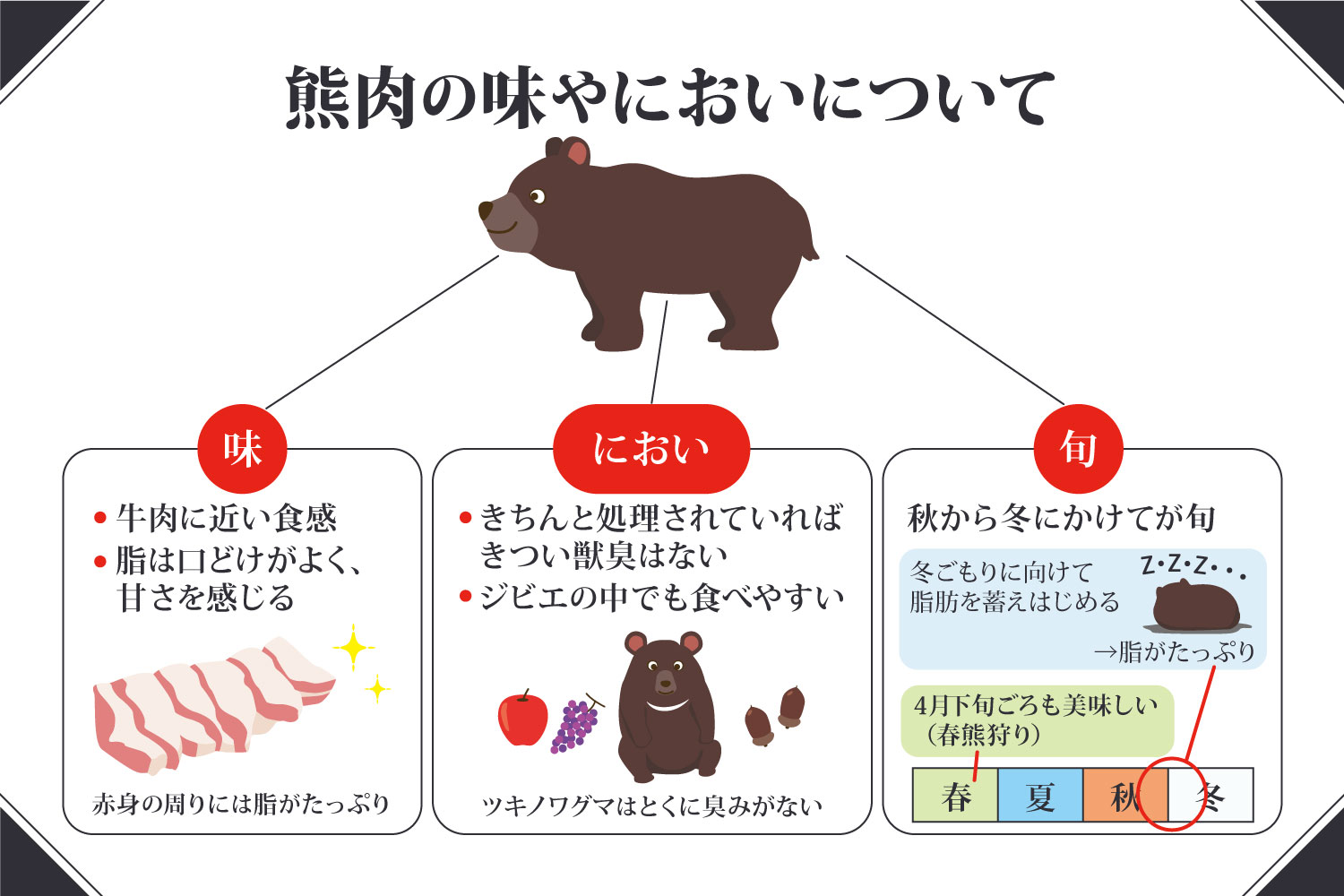
Why bear meat stands out among Japanese wild game
In the same survey, among people who eat gibier several times a month or more, 46.9% had eaten bear — behind venison (62.5%) and wild boar (59.4%). In other words, for people who eat wild game regularly, bear is the meat they come back for. There are three reasons.
- It is far less common than venison or wild boar
- Some cuts stand comparison with premium wagyu
- It is rich in vitamins and minerals
It is far less common than venison or wild boar
Bear has been eaten across Japan since long ago as a gift of the mountains. But bears live deep in the mountains, so bear meat is much harder to come by than venison (known poetically as momiji) or wild boar (botan), the two mainstays of Japanese gibier.
Most bear meat in Japan comes from brown bears hunted or culled in Hokkaido, and only a small share is brought into a meat processing facility and enters distribution. A great deal never becomes food at all, which makes bear a relatively rare ingredient even within gibier.
In some parts of Japan you can buy bear meat in a supermarket, but given how little there is and how demanding the preparation can be, ordering it at a specialist gibier restaurant is the safer bet. A specialist can serve it as hot pot, shabu-shabu, charcoal-grilled, as steak, or slow-braised. For what it is worth, when we butcher a bear for steak, more than half of what we trim turns out to be sinew and has to go into other dishes.
Some cuts stand comparison with premium wagyu
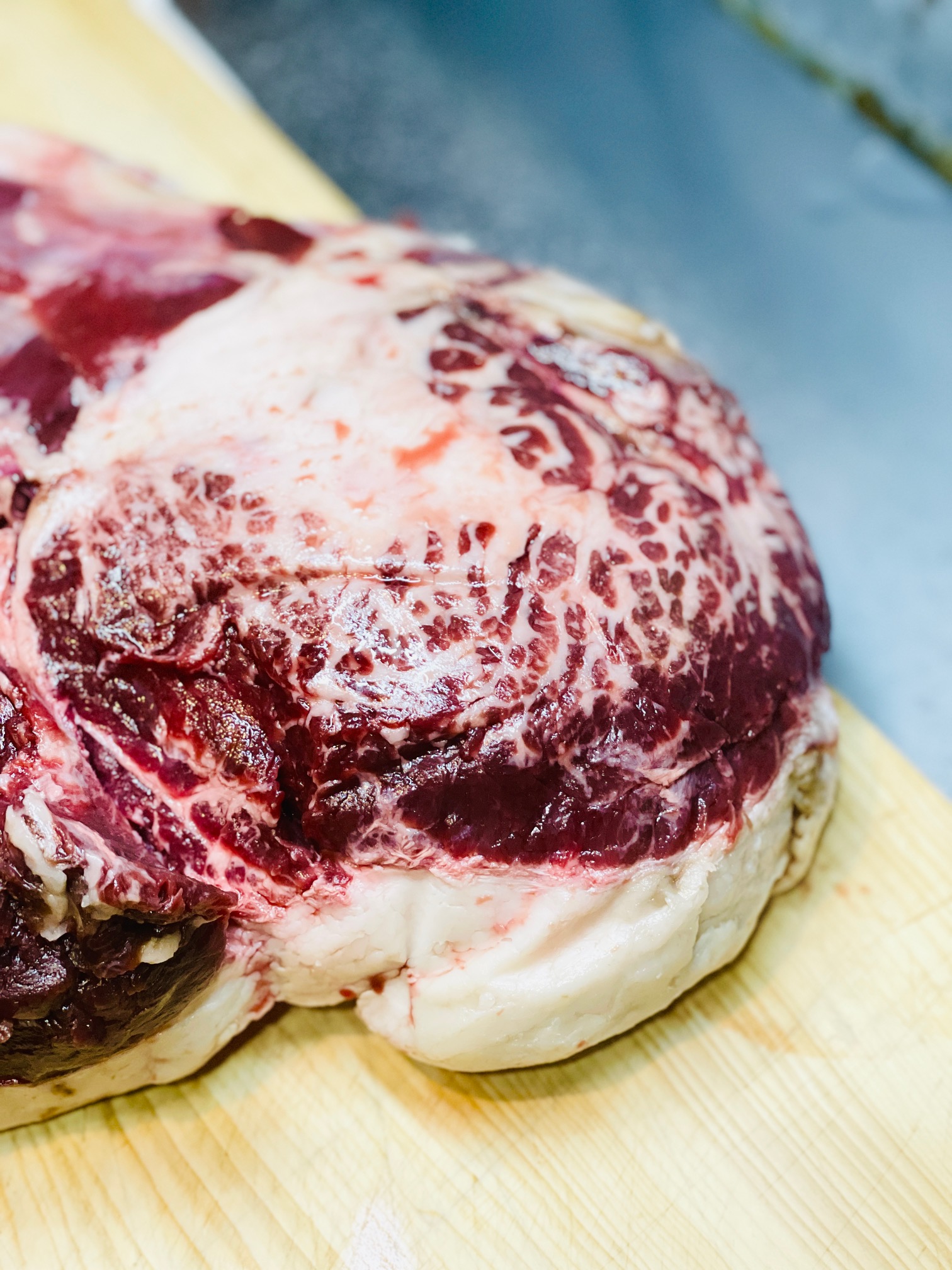
The reason so many guests want to eat it again is simply that it is hard to forget. The loin, the shoulder loin and the fillet are remarkably tender for wild meat, and they are what gibier regulars ask for.
Bear is often compared with premium wagyu. Wagyu fat has a low melting point and disappears the moment it meets your tongue; bear is different in that the savoury flavour lingers. Some guests tell us they prefer it to high-grade wagyu. For the differences between cuts and how best to cook each one, see our Japanese article 熊肉の美味しい部位はどこ?おすすめの食べ方も紹介.
It is rich in vitamins and minerals
Gibier carries vitamins and minerals that modern diets often lack. Bear is high in oleic acid, a monounsaturated fat, and it contains more vitamin B1 than wild boar; vitamin B1 helps the body produce energy. Our Japanese article 熊肉を食べて得られる効果は?美肌・貧血の改善などの効果を紹介 goes into the nutrition in more detail.
What bear meat tastes and smells like
The fat is where the flavour lives
Bear is closer to beef in texture, but it tastes quite different. What defines it is the generous layer of fat around the lean meat. That fat melts readily and carries a faint sweetness. An animal that has been feeding mainly on beech nuts has softer fat; one feeding on acorns has a stronger savoury depth. What a bear eats shows up in its fat.
Grilled plainly, or sliced thin for kuma-shabu (bear shabu-shabu), the richness of that fat comes through best. In season, when the fat is at its fullest, the wholesale price can run higher than Kobe beef.
Properly handled bear meat has very little gaminess
Bear is wild meat, so it does have an aroma and character of its own. But it is not the overpowering gamy smell people tend to imagine. If the animal was bled and dressed properly on the spot, bear is actually one of the easier wild meats to eat.
Asiatic black bears in particular are omnivores that lean heavily towards plants, living mainly on acorns, fruit and buds. Individual animals vary, but the meat does not carry the wild animal smell people expect, which makes it approachable even if this is your first gibier.
What guests say at the table, almost word for word:
“I was worried it would smell gamy, and it wasn’t gamy at all — what a surprise!”
“I like that wild character bear meat has.”
For the best bear meat, come in season
The season runs from autumn into winter. Once the hunting season opens and bears begin laying down fat for hibernation, that fat grows sweeter by the week. Sliced thin and eaten in a hot pot or as shabu-shabu, bear at this time of year is as good as it gets. More than a few guests have told us it was the best meat they had ever eaten. The more fat, the better it tastes — and the higher the price it fetches from specialist gibier wholesalers.
Brown bear and Asiatic black bear: the differences
There are eight species of bear in the world, but only two live in Japan: the brown bear (higuma) and the Asiatic black bear (tsukinowaguma, literally “moon-ring bear”, for the pale crescent on its chest).
| Brown bear | Asiatic black bear | |
|---|---|---|
| Range | Hokkaido | Honshu and Shikoku |
| Body length | Male: 150–200cm Female: 140–170cm | Male: 120–150cm Female: 100–130cm |
| Weight | Male: 100–250kg Female: 60–150kg | Male: 40–100kg Female: 30–60kg |
| Diet | Omnivorous | Omnivorous |
| Speciality | Digging | Climbing trees |
Is one of them better to eat?
Guests at our Ningyocho restaurant ask us this often: which is tastier, brown bear or black bear?
The short answer is that neither outranks the other. A brown bear is a larger animal and carries more fat; an Asiatic black bear eats more plant food, so the aroma of the meat is gentler. That is why we put together a tasting course that serves both, for guests who would rather decide with their own palate. If you would like to see what a bear dinner in Tokyo actually looks like, our English article Eat Bear in Tokyo: A Rare Wild-Game Feast in Asakusa & Nihonbashi walks through it.
How I choose bear meat
What I actually check before buying
Before we take a bear, I check a few things. I look at the hunter’s photographs of the animal as taken and as dressed, to judge how the fat sits and what condition the meat is in. I check the stomach contents, which tell me what the animal had been eating. I check the size and the age. As for smell, I rely on what the hunters I have worked with for years tell me.
For steak, I use animals of 60–100kg
Large brown bears pass 300kg, but by that size the meat has toughened. The animals we serve as steak are mostly in the 60–100kg range, where the meat stays tender enough to do justice to a steak. All of that assumes, of course, that the hunter handled the animal well.
What the bear ate changes how it tastes
The flavour of bear depends on what that particular animal lived on. The manga Golden Kamuy has a brown bear with a taste for sour berries, and I believe that is true to life. I have eaten meat from a bear that had been feeding heavily on salmon, and it carried a faint hint of fish. The same animal, taken in a different place or a different season, is a different meat altogether. That is what makes gibier interesting.
Bear compared with venison and wild boar
Most of the meat served at gibier restaurants in Japan is venison or wild boar. In FY2022, 108,892 deer (68.9%) and 36,087 wild boar (22.8%) were processed for food — together about nine tenths of the total (*).
* Ministry of Agriculture, Forestry and Fisheries, “Shitte! Tanoshimu! Gibier” p10
Venison: high in protein, low in fat
Venison is very lean. Per 100g, beef comes to 294kcal while venison is less than half that at 119kcal, with only 4.0g of fat — lower than bear. It carries 23.9g of protein per 100g, above beef’s 17.1g. Protein varies by animal, but bear is generally the richer of the two.
Wild boar: rich in iron and vitamin B12
Wild boar has long been eaten in Japan as a restorative food. In protein and fat it is close to pork, but it carries more B vitamins and more iron. Set against bear, though, bear has more vitamin B1.
Food safety: licensed facilities and thorough cooking
In Japan, the meat of wild birds and animals must pass through a licensed meat processing facility before it can be distributed. The bear we buy is no exception: it all comes from licensed facilities.
We always cook bear thoroughly before it reaches your table. Bear paw is the extreme case: half a day of initial simmering, then another five to twelve hours of braising. That long cooking is there to draw out any gaminess, and it also means the meat arrives fully cooked through.
It is a fair thing to wonder about when you are eating wild meat for the first time, so we would rather say it plainly here.
How to reserve (English, online)
We are reservation-only, so please book in advance. Tabelog, Japan’s largest restaurant site, has an English version, and you can book there without any Japanese.
Restaurant information
Amakara Kumakara — Asakusa
- Address: 1-20-5 Asakusa, Taito-ku, Tokyo 111-0032 (1 minute on foot from Kaminarimon)
- Phone: 03-5828-6788
- Hours: Mon, Wed–Sat 17:00–22:30 (last order 21:30) / Sun and public holidays 17:00–22:00 (last order 21:00)
- Closed: Tuesdays, 31 December and 1–3 January
- Seats: 52 (tatami seating, sunken-table seating, counter)
Amakara Kumakara — Nihonbashi Ningyocho
- Address: Okawa Building 2F, 3-7-11 Nihonbashi Ningyocho, Chuo-ku, Tokyo 103-0013 (1 minute on foot from exit A5, Ningyocho Station, Tokyo Metro Hibiya Line)
- Phone: 03-5640-2121
- Hours: 17:00–22:30 (last order 21:30)
- Closed: Sundays and public holidays
- Seats: 20 (including sunken-table private rooms)
About the author
This article was written by Ikuo Hayashi — Representative Director of the Bear Meat Utilisation Research Institute (a Japanese general incorporated association), gibier critic, and owner of the gibier restaurant Amakara Kumakara.
He entered the restaurant trade in 1987 and opened his own place in Nihonbashi Ningyocho, Tokyo, in 1996, incorporating as Tina’s Dining Co., Ltd. in 2000. Today he runs Amakara Kumakara, where guests can eat bear, deer, wild boar and wild birds, and Ramurenkayne, where Ainu dishes are served alongside Ainu cultural traditions. His restaurants have been featured on television programmes including TBS’s Love it! and NHK’s NHK Special, and in newspapers and magazines such as Nikkan Sports and Otona no Shumatsu.